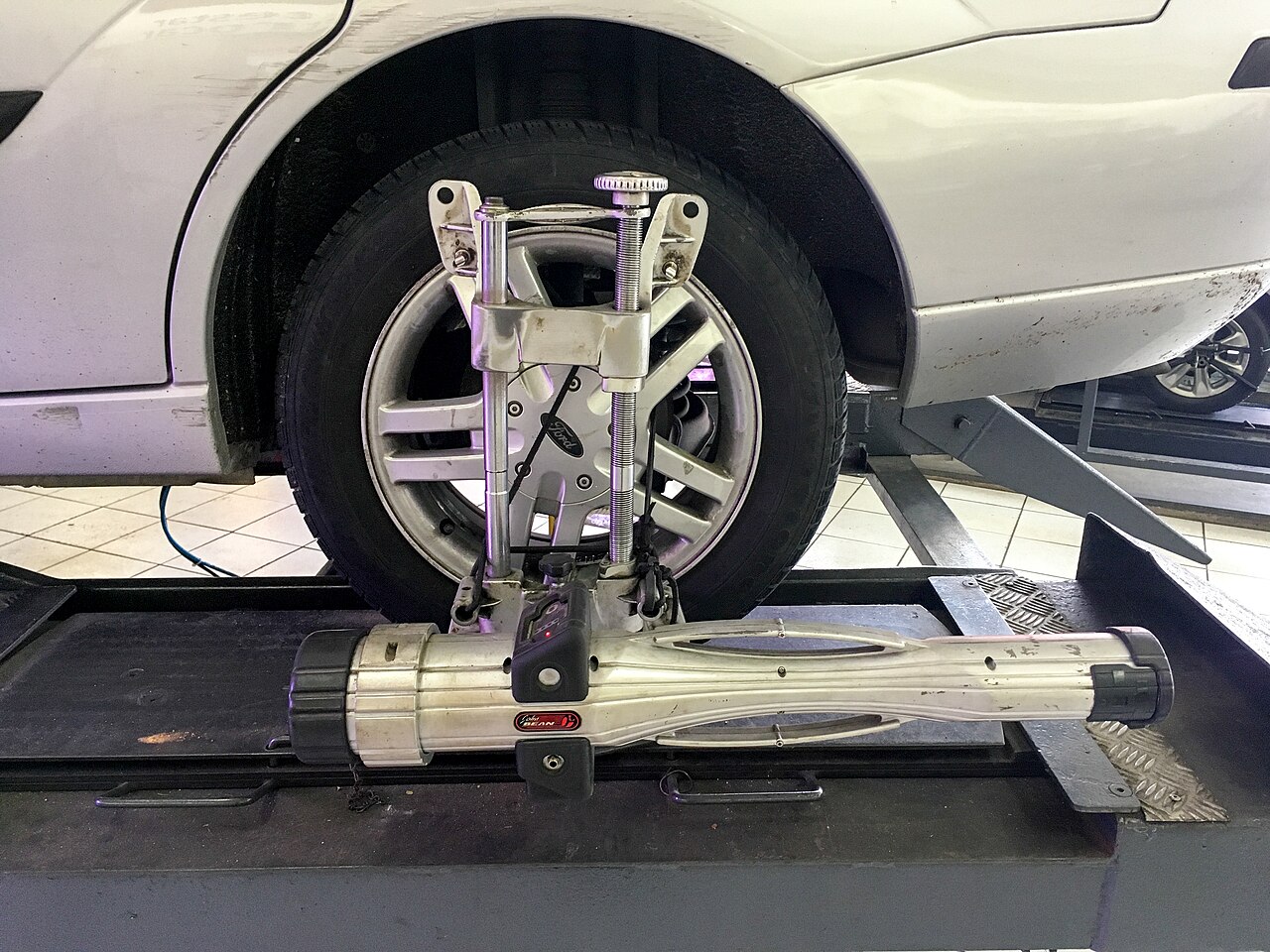
 You're rolling west on Hallandale Beach Boulevard past the big oak at Three Islands, windows down, and the steering wheel has that slight tug to the right it's had for weeks. You pull into the Publix lot at Federal, shut off the engine, and walk around the front passenger tire — the inside shoulder is bald down to the wear bars while the outside tread still has deep grooves. That lopsided pattern isn't random. It's the tire telling you the wheel is leaning in at the top, and every mile you drive scrubs rubber off that inside edge.
Inside-edge wear happens when the top of your wheel tilts inward toward the engine — that's negative camber. The tire rides on its inner shoulder instead of flat across the tread, so the inside edge wears down fast while the outside looks nearly new. A camber angle more than about half a degree off spec can chew through a tire far sooner than its rated life.
What is camber and why does it matter?
Camber is the tilt of the wheel when you look at the car from the front. Zero camber means the wheel stands straight up. Negative camber means the top leans in toward the car. Positive camber means the top leans out. Most passenger cars run a small amount of negative camber — usually between zero and one degree — because it helps the tire keep full contact when the body rolls in a turn. But when that angle goes beyond what the manufacturer spec calls for, the tire stops rolling flat and starts dragging its inside edge on every straight mile. Think of a rolling pin. If you hold it perfectly vertical and roll it across the counter, the whole surface touches evenly. Tilt the top toward you and roll — only the edge near your hands makes contact. That's what negative camber does to your tire. The contact patch shrinks to a narrow band on the inside shoulder, and that band does all the work: braking, accelerating, carrying the corner weight. It heats up faster, wears faster, and loses grip in wet conditions because the water can't escape from a contact patch that narrow.How do I know if my camber is off?
The wear pattern is the loudest clue. Run your hand across the tread from outside to inside. If the inside shoulder feels smooth or you can see the wear bars flush with the tread while the outside still has 6/32 or more, that's the signature. You might also feel a steady pull to one side on a flat road, or the steering wheel sits crooked when you're tracking straight. Some cars — especially lowered ones or vehicles with worn control-arm bushings — develop extra negative camber over time without any single hard impact.What causes camber to go out of spec?
Suspension parts move. Bushings crack and soften. Ball joints develop play. Strut mounts shift. A hard pothole on I-95 near the Hollywood Boulevard exit can bend a control arm just enough to add a quarter degree of negative camber — enough to ruin a set of tires in a single season. Lowering springs change the geometry by design; if you don't install adjustable camber arms or camber plates afterward, the wheels tuck under at the top. Even a minor fender-bender that tweaks the subframe can shift the mounting points.Can I check camber myself?
You can spot the wear pattern yourself, but measuring the actual angle takes a camber gauge or an alignment rack. A magnetic bubble gauge that clamps to the hub gives you a rough reading — usually within a tenth of a degree if you're on level ground. Park on a flat section of your driveway, not the crowned street. Turn the wheel straight, clamp the gauge, and read the bubble. If it shows more than about negative one degree on a car that specs zero to negative half a degree, you've found the problem. But the gauge won't tell you *which* part is bent or worn. That takes a full alignment check with the car on a rack and the suspension loaded.Why does inside-edge wear happen faster than outside-edge wear?
Weight distribution. The engine and transmission sit over the front wheels on most cars. That weight presses the inside shoulder harder into the pavement when the top of the wheel tilts in. The outside shoulder barely touches. So the inside edge carries more load per square inch of rubber. Heat builds faster there. The rubber compounds break down quicker. And because the contact patch is narrow, the tire can't shed water as well — hydroplaning risk goes up even when the outside tread looks fine. Imagine a kitchen knife. Press the flat side against a cutting board — the force spreads out. Now press just the tip. Same force, tiny area, much more pressure. That's your inside shoulder under negative camber. Every mile is a slicing motion on that narrow band.Will rotating tires fix inside-edge wear?
Rotation moves the worn tire to a different corner, but it doesn't change the camber angle that caused the wear. If the left front has bad negative camber, moving that tire to the right rear just gives the right rear the same angled wear — assuming the rear also has negative camber (many do). Rotation buys you a little time if the wear is mild and you're fixing the alignment *this week*. But if the camber is still off, the new position will wear the same way. Rotation is maintenance, not repair.What does an alignment actually adjust?
A four-wheel alignment measures and sets three angles on each wheel: camber (the tilt we've been talking about), toe (whether the fronts of the tires point toward or away from each other), and caster (the steering-axis tilt front-to-back that affects stability). On many cars, only toe is adjustable from the factory. Camber and caster are fixed by the stamped position of the strut tower and control-arm mounts. If camber is out on those cars, something is bent or worn — or you need aftermarket adjustable parts like camber bolts, eccentric bushings, or slotted strut mounts to bring it back in range.How long can I drive on tires with inside-edge wear?
If the cords are showing or the wear bars are flush on the inside shoulder, the tire is unsafe — stop driving on it. If you have 2/32 left on the inside but 6/32 on the outside, you're borrowing time. The tire can fail suddenly when the thin shoulder hits a pothole or overheats on a long highway run. In South Florida heat, pavement temperatures soar in July. That heat softens the already-thin rubber faster. Plan to replace the tire and fix the alignment together. Putting new tires on a car with bad camber just buys you a fresh set of tires to ruin. Watch the video below for a visual walkthrough of this topic — a companion to the points above.When to call us
DIY is great, but some jobs need a pro. If the problem persists, you spot anything dangerous, or you'd rather have an expert handle it, call (754) 243-8415 — Hallandale Mobile Tire serves Hallandale Beach and Broward (Mon-Sat 8AM-8PM). No pressure, no upsells.
Stuck on the Shoulder Right Now?
Hazards on, passenger-side exit, call dispatch. We roll in 15 minutes.
📞 Call (754) 243-8415If You Don't Have a Spare
Many newer vehicles (and most diplomat-garage vehicles) ship without a spare. If that's you, our Diagnostic is the next read: scenarios/no-spare-tire.html. Service call is $40 with a $40 booking hold, and we get you home or to a shop.