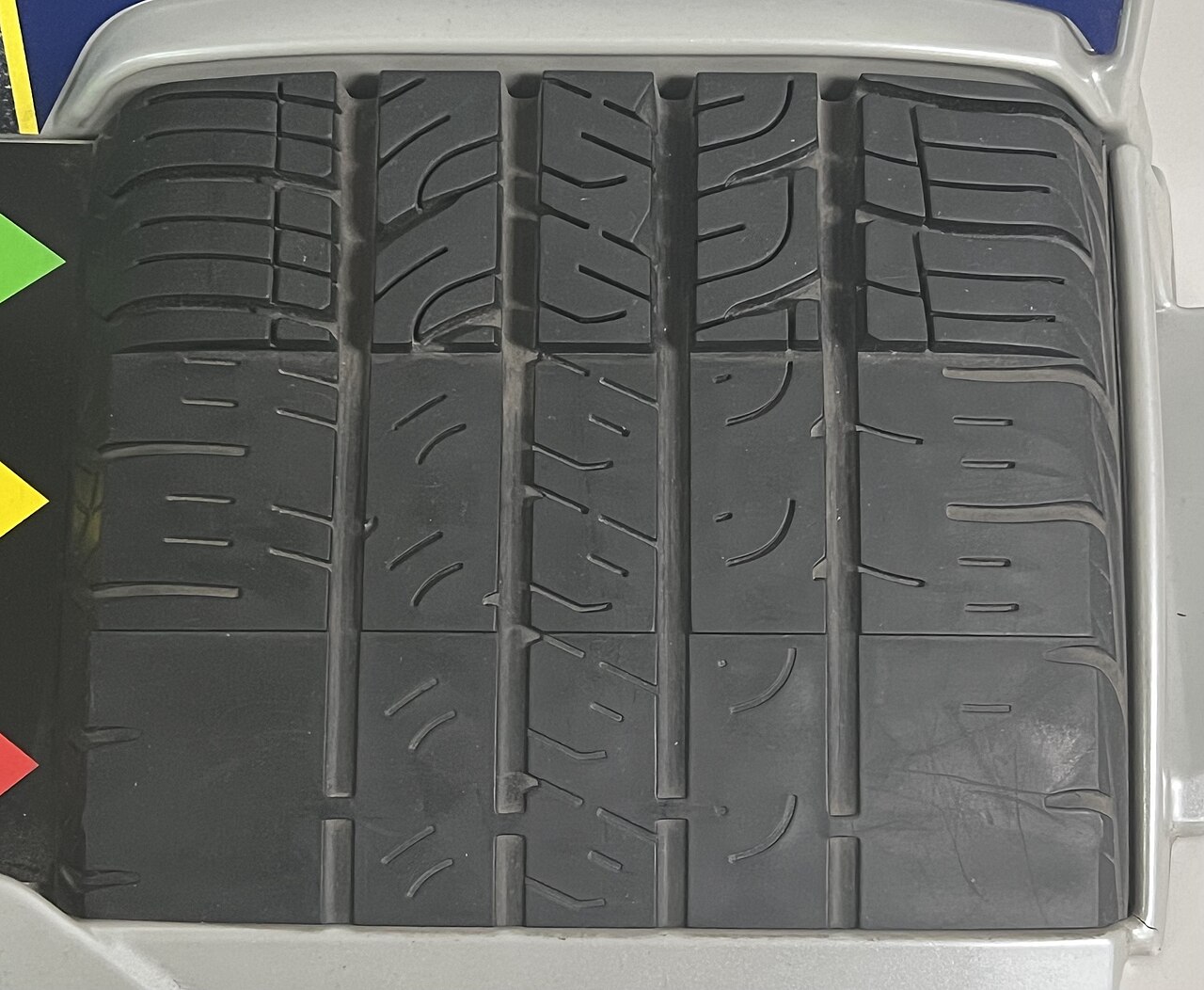
It's 6:40 on a Tuesday and you're merging onto I-95 at Hallandale Beach Boulevard when the sky opens up — one of those South Florida downpours that turns the expressway into a river in ninety seconds. Your tires are the only thing between you and the guardrail, and right now they're riding on rubber you haven't measured since you bought the car. A tread depth gauge costs less than a drive-through lunch, takes thirty seconds a tire, and tells you exactly how much grip you have left. Here's how to use one.
A tread depth gauge measures how much usable rubber is left in your tire's grooves, in 32nds of an inch. Push the probe into a tread groove until the gauge's flat base sits flush on the tread, then read the depth where the barrel meets the casing. New tires read 10/32 to 12/32. At 4/32, start shopping. At 2/32 — the legal minimum in Florida — the tire is done, especially before rainy season. Measure three spots across each tire: inner, center, and outer.
What exactly does the gauge measure, and why 32nds?
The reading comes in 32nds of an inch because tire wear happens in tiny increments. The scale that matters: a new all-season tire starts around 10/32" to 11/32" deep, and every 1/32" you lose is roughly 3,000 to 5,000 miles of driving.
How do I take a reading, step by step?
1. Park on flat ground, engine off. Turn the steering wheel fully to one side so you can reach the front tires' grooves easily.
2. Find the wear bars first. Look inside the main grooves for small raised bridges of rubber running across the groove — those are the wear bars, molded at exactly 2/32". If the surrounding tread is flush with the wear bars, you don't need the gauge to know the answer. But the gauge tells you how far above that line you still are.
3. Seat the gauge. Hold the gauge barrel between your fingers, extend the probe, and push it straight down into a center groove until the flat circular base sits flush against the tread blocks on both sides. Keep it perpendicular — tilting the gauge even slightly gives a false deep reading.
4. Read where the barrel meets the probe housing. On a plunger-style gauge, the probe slides up into the barrel as you press; the depth is the number visible at the top edge of the barrel. Read it in 32nds. Write it down.
5. Measure three spots per tire. Inner edge, center, outer edge. This is the step everyone skips, and it's the most important one: even readings mean the tire is wearing normally. An inner edge at 4/32" while the center reads 8/32" means your alignment is off or the tire is underinflated — the tire isn't worn out, it's wearing wrong, and a new tire will do the same thing.
6. Repeat on all four. Front tires wear faster on most cars (they steer and, on front-wheel-drive, pull). Thirty seconds a tire, two minutes total.
What do the numbers mean for my driving?
10/32" to 8/32": New to nearly new. Full wet grip. Carry on.
7/32" to 5/32": Healthy middle life. Still fine in rain, but this is when to start paying attention before the next rainy season.
4/32": The quarter test — stick a quarter upside down in the groove; if the tread doesn't reach the top of Washington's head, you're at 4/32" or less. Wet stopping distances start growing here. In South Florida, where a sunny morning turns into a flooded afternoon, 4/32" is your shopping signal.
3/32": Replace soon. Hydroplaning risk climbs fast below this — at highway speed, your tires need deep grooves to pump water out from under the contact patch. Shallow grooves can't move the water, and the tire starts surfing.
2/32": The penny test — Lincoln's head fully visible means 2/32", the legal minimum in Florida. The tire is done; in a downpour it has roughly half the wet traction it had new.
One Florida-specific note: our heat and UV age rubber even when tread looks fine. A tire with 6/32" left but cracked sidewalls or a DOT date code older than six years is still a replace candidate — dry-rotted rubber doesn't grip, no matter what the gauge says.
Can I watch someone use a gauge before I buy one?
Yes — thirty seconds of watching beats a page of instructions. In this video, 4DIYers walks through a plunger-style gauge on two real tires: a nearly new tire reading 9/32" and a set of winter tires reading 7/32" and 5/32". Watch how he keeps the gauge base flat on the tread and reads the barrel — that's the whole technique. He also points out the wear bars and shows both the imperial and metric scales on the gauge.
Video summary: A DIY channel demonstrates a plunger-style tread depth gauge on real tires — seating the base flat in the groove, reading 9/32" on a new tire and 7/32" and 5/32" on worn ones, and pointing out the molded wear bars. Shows exactly how to hold the gauge and where to read the measurement.
Gauge, penny, or quarter — which should I actually use?
The gauge wins on precision — it tells you 5/32" versus 4/32", and that 1/32" is the difference between "fine for now" and "shop this month." The penny and quarter are binary pass/fail checks: penny for the 2/32" legal line, quarter for the 4/32" shop-now line. Use the coins for a quick monthly driveway check; use the gauge when you're deciding whether to buy now or after the next paycheck, and always when readings differ across the tire. It lives in the glove box and costs less than the air freshener hanging from your mirror.
When should I call Hallandale Mobile Tire instead?
Measuring is DIY. What the numbers reveal sometimes isn't. Call us at (754) 243-8415 when:
- Readings differ by more than 2/32" across one tire — that's uneven wear from alignment, balance, or pressure issues, and it needs a tech's eyes.
- You're at 4/32" or below and want real options — we'll tell you honestly whether you can wait out the dry months or need rubber before the next storm.
- You see cracking, bulges, or the wear bars are flush — that's a safety call, not a shopping trip.
- You just don't want to crawl around a parking lot with a gauge — we'll come measure and advise on the spot.
We serve Hallandale Beach and all of Broward, Monday through Saturday, 8AM to 8PM, and we're mobile — driveway, office lot, wherever the car is. No pressure, no upsells: if your tread's fine, we'll say so and be on our way.
Stuck on the Shoulder Right Now?
Hazards on, passenger-side exit, call dispatch. We roll in 15 minutes.
📞 Call (754) 243-8415If You Don't Have a Spare
Many newer vehicles (and most diplomat-garage vehicles) ship without a spare. If that's you, our Diagnostic is the next read: scenarios/no-spare-tire.html. Service call is $40 with a $40 booking hold, and we get you home or to a shop.