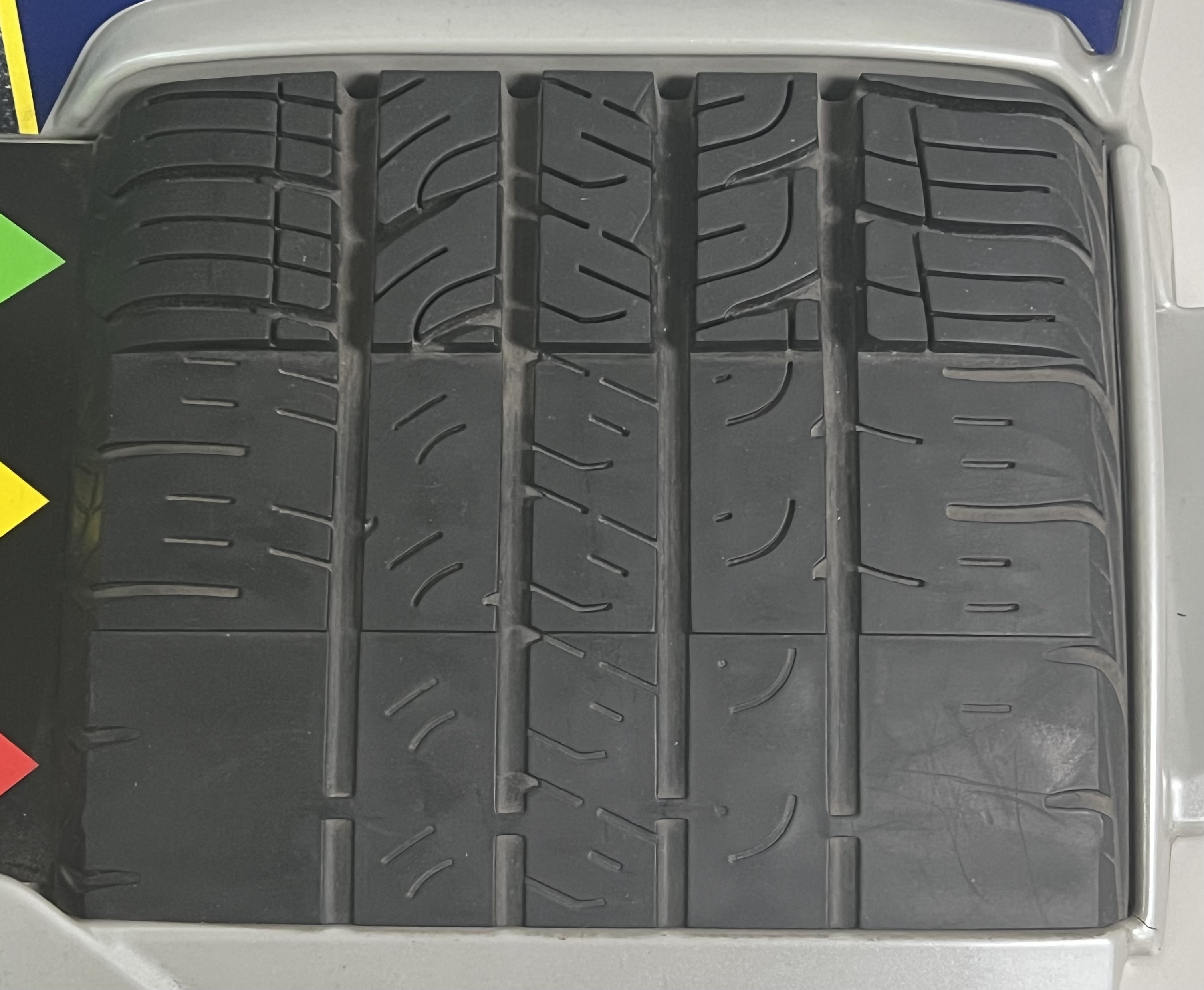
It's the kind of October morning Hallandale Beach does best — warm enough for the windows down on the way to the sand. You're walking back to your car from the beach access at South City Beach Park when you notice it: the grooves in your front tires look shallow, almost smooth in the middle. You can't tell if you're due for new rubber or just imagining things. Here's the good news — you can get a real answer in about thirty seconds with a single penny.
Push a penny into your tire's tread groove with Lincoln's head upside down, facing you. If you can see the top of Lincoln's head, the tread is worn down to 2/32 of an inch or less — the legal minimum in most states — and the tire needs to be replaced. Check a few spots on each tire: the center, the inner edge, and the outer edge.
How does the penny test actually work?
The test works because the distance from the edge of a penny to the top of Lincoln's head is about 2/32 of an inch. That number matters because 2/32" is the point where a tire's ability to grip wet pavement drops off hard. The National Highway Traffic Safety Administration advises against driving on tires with tread below 2/32", and in most states it's the legal minimum — the U.S. Tire Manufacturers Association considers a tire at 2/32" to have reached the end of its useful life. For context, brand-new tires typically start around 10/32" to 11/32".
Here's the exact technique. Find a main tread groove — one of the deep channels that runs around the tire, not the thin decorative sipes. Hold the penny between your fingers with Lincoln's head pointing down, toward the tire, and his face turned toward you. Push the penny straight down into the groove until it bottoms out. Don't tilt it sideways; if the penny leans, you won't get an honest reading. Now look: if the top of Lincoln's head is hidden by the tread, you've got more than 2/32" left. If his whole head — forehead and all — is visible above the tread, you're at or below the minimum and it's time to shop for tires.
One penny can't tell the whole story, so repeat the test in three spots on every tire: the center of the tread, the inner edge, and the outer edge. Tires wear unevenly, and a tire that passes in the center can fail on the inside edge where you rarely look. While you're down there, glance at the sidewalls for cracks, bulges, or anything stuck in the tread. The test takes two minutes for all four tires plus the spare.
What should you watch for while you test?
The penny test is simple, but a few details make it more trustworthy. First, test more than one groove — run the penny through several of the main channels on each tire. Second, pay attention to uneven wear. If Lincoln's head disappears in the center but shows on both edges, the tire may be underinflated; if the center fails while the edges pass, it may be overinflated. Feathered or cupped wear can point to alignment or suspension issues worth having checked.
Third, check your tire pressure while you're at it. An underinflated tire wears the shoulders faster and runs hotter, which shortens its life and can hurt fuel economy. Your car's correct pressure is on the sticker inside the driver's door jamb — not the number stamped on the tire sidewall, which is the tire's maximum, not your car's target. (We have a full step-by-step on checking pressure correctly elsewhere on this blog.)
And a heads-up on limits: the penny test only measures 2/32". If you want an earlier warning, the quarter test works the same way for 4/32" — Washington's head upside down in the groove, and if you can see the top of his head, you're at 4/32" and should start planning for replacements, especially with Florida's rainy season in mind. For a truly exact number, a tread-depth gauge costs a few dollars at any auto parts store.
What the video shows
The 2-Minute Mechanic's quick demo walks through the penny test in real time: where to place the penny in the tread groove, how Lincoln's head should sit, and what "pass" versus "fail" looks like on actual tires. It's a short watch and a good visual backup for the steps above.
When should you skip the penny and call a pro?
The penny test is a screening tool, not a full tire inspection. Call a tire professional if the penny shows worn tread on any tire, if you spot uneven wear, bulges, sidewall cracks, or a nail in the tread — or if you're just not sure what you're looking at. Driving on bald tires in South Florida's sudden downpours is asking for hydroplaning, and no coin test fixes a tire that's already at the limit.
If your tires fail the test — or you're due for a second opinion — Hallandale Mobile Tire comes to you anywhere in Hallandale Beach and Broward, Monday through Saturday from 8am to 8pm. Call (754) 243-8415 and a senior tire technician will check your tread, your pressure, and your options on the spot — no shop visit, no waiting room.
Stuck on the Shoulder Right Now?
Hazards on, passenger-side exit, call dispatch. We roll in 15 minutes.
📞 Call (754) 243-8415If You Don't Have a Spare
Many newer vehicles (and most diplomat-garage vehicles) ship without a spare. If that's you, our Diagnostic is the next read: scenarios/no-spare-tire.html. Service call is $40 with a $40 booking hold, and we get you home or to a shop.